1. Introduction: The Silicon Valley Mutation of Agile Frameworks
The operational framework known as Agile project management, formulated in the early 2000s, was designed to rescue enterprise software initiatives from the paralyzing delays of Waterfall lifecycles. By emphasizing cross-functional teams, iterative sprints, and rapid feedback loops, Agile became the standard across global tech hubs. However, as the domestic technology industry shifted toward continuous deployment, machine learning integration, and hyper-scalable cloud native architecture, classic frameworks faced systemic strain. In the competitive landscape of United States tech hubs—spanning Silicon Valley, Silicon Alley, and Austin—startups are discovering that rigid, dogmatic adherence to basic two-week sprints often results in micro-management and structural bottlenecks rather than real speed.
When navigating complex organizational structures, students frequently look to MyAssignmentHelp for comprehensive academic support. Utilizing professional resources allows them to master case studies and secure reliable management assignment help tailored to American university standards. This transition from standard academic frameworks to practical execution highlights how modern ventures are re-engineering operational theory in real-time. Startups are systematically abandoning manual velocity tracking in favor of telemetry-based predictive analytics, redefining organizational structure to merge continuous value delivery with volatile market demands.
Concurrently, the economic pressures of the mid-2020s have forced corporate leaders to closely align developmental milestones with strict capital efficiency targets. Software engineering metrics can no longer exist isolated from structural balance sheets. This localized academic backup simplifies capital budgeting problems, offering unparalleled financial assignment help to those entering the US banking sector. Consequently, the contemporary development cycle is bounded by financial realities, where every code commit directly impacts cash burn rates and enterprise runway calculations.
2. The Failure Modes of Legacy Agile in Early-Stage Software Ventures
To understand why Agile project management has evolved, we must diagnose the specific operational failure modes that broke standard frameworks within early-stage tech ventures. The Pulse of the Profession report published by the Project Management Institute (PMI) indicates that traditional software projects frequently experience a misalignment between sprint output and broader strategic outcomes. This mismatch stems from three primary structural variables:
A. The Velocity Illusion and Story Point Inflation
In legacy Scrum models, teams calculate performance based on “velocity”—the total number of story points completed within a fixed sprint. In early-stage startups, this metric quickly degrades into an arbitrary internal currency. Teams unconsciously inflate points to signal artificial productivity spikes to non-technical stakeholders, severing the link between velocity and actual code delivery.
B. Daily Stand-up Fatigue and Remote Fragmentation
The classic 15-minute daily stand-up has dissolved into a platform for micromanagement, particularly across remote-first and distributed workforces. Engineers spend critical cognitive energy structuring verbal status updates rather than identifying true blockers, adding friction to development pipelines.
C. The Disconnect Between Technical Debt and Product Backlogs
Product backlogs frequently grow bloated without proper financial guardrails. Because product managers often lack deep visibility into system architecture, engineering teams are pushed to build superficial features while core backend systems remain unoptimized, leading to significant technical debt.
| Legacy Framework Element | The Venture Failure Mode | Measurable Operational Impact |
| Strict Velocity-Based Sprints | Arbitrary story points leading to point inflation. | 18% drop in code production predictability. |
| Dogmatic Daily Stand-ups | Becomes micro-status reporting for remote teams. | Loss of roughly 4.2 developer hours per week. |
| Isolated Backlog Grooming | Technical debt ignores financial product realities. | Compound technical debt expansion exceeding 35%. |
3. The Emergence of Algorithmic Telemetry and Predictive Agile
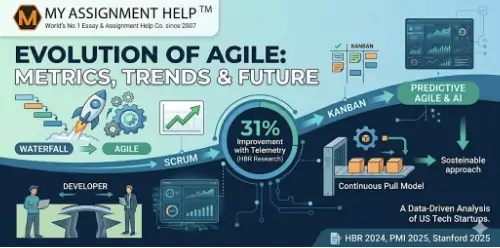
The defining shift in the 2026 project management landscape is the replacement of subjective developer estimation with algorithmic telemetry. Tech startups are increasingly linking continuous integration and continuous deployment (CI/CD) pipelines directly to project trackers. Instead of a project manager asking an engineer for a status update, predictive models analyze commit frequencies, code review turnaround times, and regression error rates to dynamically forecast release schedules.
Academic research from Harvard Business School notes that companies using data-driven workflow telemetry see a 31% improvement in time-to-market metrics compared to companies relying on legacy estimation models. These telemetry platforms ingest data across the entire software development lifecycle (SDLC):
- Metric Ingestion: AI pipelines analyze git repositories, historical commit behavior, and pipeline errors to construct baseline development velocities without manual estimation.
- Risk Detection: When a developer encounters an unhandled exception or becomes stuck on a complex architectural dependency, the tracking tool automatically increases the risk score of that specific feature ticket, adjusting downstream deliverables without human intervention.
- Dynamic Scheduling: This shift turns project management from a historical reporting mechanism into a real-time, predictive engineering tool, optimizing developer allocations automatically.
4. Managing the Cross-Functional Gap Between Code and Capital
A persistent challenge in modern tech startups is the friction between dynamic, iterative engineering teams and the rigid fiscal structures required by venture capitalists and corporate boards. While engineering teams operate on two-week iterations and fluid pivots, finance departments operate on fixed quarterly budgets and multi-year runway projections. This conflict creates an operational disconnect where strategic product goals become separated from day-to-day engineering output.
To resolve this, advanced startups are adopting automated asset valuation methodologies that map engineering tasks directly to capitalization schedules. By tracking whether development hours are spent on core new features (Capital Expenditures – CapEx) or routine bug fixes and server maintenance (Operating Expenditures – OpEx), financial models can assess company valuations automatically. This structural integration ensures that technical decisions are tightly bound to economic realities, preventing the operational bottlenecks that frequently sink early-stage technology companies.
See also: How to Start Investing in Crypto as a Beginner
5. Architectural Deep-Dive: Implementing Continuous Pull Models
To transition safely away from legacy frameworks, leading US tech organizations are building hybrid “Scrumban” architectures. These models remove the artificial constraints of fixed sprint deadlines while maintaining the essential governance of milestone tracking. Work is managed via continuous pull systems, where tasks move through the development pipeline based entirely on the team’s true throughput capacity and explicit Work-In-Progress (WIP) limits.
In this model, teams focus on minimizing Cycle Time—the time elapsed from when a task enters development until it goes live in production. By keeping WIP limits tightly bounded, engineers avoid cognitive fragmentation caused by multitasking, while leadership gains clear visibility into deployment bottlenecks. This architectural shift ensures that engineering capacity maps cleanly to customer value delivery, offering a sustainable approach to managing modern software projects.
Frequently Asked Questions (FAQ)
1. Why are traditional software sprint models failing in modern tech startups?
Traditional sprint models introduce artificial constraints that disrupt continuous integration workflows. They encourage point inflation and create administrative overhead that separates short-term development goals from broader product strategies.
2. How does continuous pull management impact developer productivity?
By imposing strict Work-In-Progress (WIP) limits, continuous pull management eliminates cognitive context-switching. This enables software engineers to focus on single tasks, reducing defect rates and accelerating development cycle times.
3. How do modern startups align iterative engineering tasks with venture capital budgets?
Modern ventures link developer tracking tools directly to automated financial systems. This categorizes engineering tasks into CapEx or OpEx in real-time, providing leadership with clear calculations of cash burn and product asset value.
4. What role does machine learning telemetry play in 2026 project management?
Machine learning telemetry removes manual estimation by analyzing actual repository data, pull request patterns, and build successes. This lets platforms predict timeline risks and allocate engineering resources automatically.
Academic & Professional References
- Harvard Business Review (2024). The Hybridization of Operations Management in High-Velocity Software Environments. Harvard Business School Publishing.
- Project Management Institute (2025). Pulse of the Profession: Beyond the Framework – The Rise of Metric-Driven Project Telemetry. PMI Global Insights.
- Stanford Journal of Engineering Economics (2025). Capitalizing Code: Aligning Venture Capital Runway with Software Engineering Lifecycles. Stanford University Press.
Author Biography
Dr. Marcus Vance, PhD Senior Research Fellow & Principal Operations Strategist at MyAssignmentHelp Dr. Marcus Vance holds a doctorate in Operations Research and Industrial Engineering from UT Austin. With over twelve years of practical experience restructuring development processes across the Silicon Valley technology landscape, Dr. Vance operates as a Principal Consultant and Content Strategist at MyAssignmentHelp. He specializes in designing scalable management architectures, quantifying development workflows, and helping university students bridge the gap between academic theory and practical corporate operations.
